Search This Blog

Showing posts with label Ireland. Show all posts

Saturday, October 15, 2016

Ireland, part 4: Killarney and County Kerry


It only rained one day of our two week trip, and it was the day of our longest drive: Sligo to Killarney.  There were some attractions we'd hoped to see along the way that we omitted.  We had an outdoor lunch at Durty Nellie's, the tavern that's been serving the servants of Bunratty Castle since 1620.  The castle itself we skipped (plus a possible stop in Galway or Connemara), since our drive was taking longer than expected due to the rain.

We checked into our B&B then stopped at St. Mary's Cathedral.  There is a giant sequoia right in front, planted on a famine grave -- its seeds had been a gift from the people of California. An unexpected surprise.


 Inch Beach:  So Tranquil!
We drove the Dingle Peninsula and Slea Head Drive the next day, with so many stops along the way.  The first stop was the amazing Inch Beach.  So flat. So calm. So blue. Everything along the drive was lovely. Rolling hills, beautiful ocean, even a peek (only) at the Skellig Michael islands where the last scene from Star Wars episode 7 was filmed. Later in the day we saw locations used for episode 8.  Yes, my boys are Star Wars fans, as well as Game of Thrones.
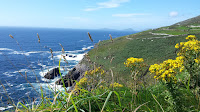
Look for this view in Episode VIII!
We paid to feed some sheep and see a Lios (earthen ring fort), then later paid for Dunbeg stone fort (500 BC), neither of which gave us much information or offered tour guides.  After so many wonderful OPW sites, it was hard not be a little disappointed in that, but the feeling was minor. The Gallarus Oratory was so impressive:  a 1200 years old church that's still waterproof, even though it was built without mortar.  We lingered on the Dingle Peninsula, ate some Murphy's ice-cream, then spent an hour or so walking around Killarney so I could purchase an Aran wool sweater.
Dunbeg Fort, about 2500 years old

Gallarus Oratory


 The following day we set out for Killarney National Park. First stop, a tour of Ross Castle.  I was always happy to have a tour guide when we visited historic sites, but on occasion we did explore on our own.  This time, we went with a guide, so learned more about the construction of the castle doors, the uniqueness of the spiral staircase, and other interesting tidbits that we wouldn't have known otherwise. No pictures were allowed inside (not even without flash), which was not common in Ireland.


Next up was Muckross Abbey, with a walk past fields with beautiful black cows.  The abbey ruins were marvelous.  There's a lovely yew tree in the center of the cloisters, possibly they were built around the already mature tree, making it well over 600 years old.  My boys loved climbing around ruins such places, so we always lingered.
Yew tree in the cloister
 
Muckross Abbey, established 1448
We did the short hike to Torc Waterfall next.  This was a crowded location, but the falls were lovely and powerful, so I'm glad we stopped.
Ladies' View
   

We had a late lunch at the Ladies' View, overlooking the lakes of Killarney National Park.  Our outdoor table afforded us a fabulous view.  We drove further into the park, probably took a wrong turn or two, but the views were so amazing that we just kept going.  Eventually we figured out that we'd driven through the Black Valley and were headed to the Gap of Dunloe.  It was later in the day, so not many people (or vehicles), so we drove though it.  Amazing.  It would have been nice to hike it, but we would have certainly needed the entire day.  By the time our drive ended, it was nearly time to go The Jarvey's to hear some trad music and see some Irish step dancers.
Which way?  No signs!
   

On Wednesday, it was time to leave Killarney for the relatively short drive to Ennis, our fifth and final stop of this fantastic trip.  That's right, somehow we missed most of the famous Ring of Kerry.  We'd hoped to get down to Mizen Head as well, but there wasn't enough time.  And there were only three days left!  Looks like we'll be back in Ireland someday!

Check out the final installment of our wonderful trip:  http://readyforthenextvacation.blogspot.com/2016/10/ireland-part-5-ennis-and-county-clare.html

Ireland, part 3: County Sligo (Mayo and Leitrim too)


The Great Room in Donegal Castle
 We drove to Sligo following three nights in Northern Ireland.  Along the way we intended to stop in Derry and walk the medieval wall, but somehow (I don't recall why) wound up touring Castle Donegal and walking through the town there instead.  No complaints!  The castle was wonderful and was a great stopping point to break up our drive.


We stayed for three nights in St. Angela's College Student Residences in Sligo. Yes, we were in student dorms that get rented out during the nonacademic year.  Great idea, actually.  We were in a spacious apartment with two bedrooms, full kitchen, fireplace in the living room, and picture windows overlooking Lough Gill.  The manager of the apartments took us up to the roof to give a us a quick verbal tour of the area and some helpful tips.

After dinner at the recommended Yeats Inn, we went to visit the grave of W.B. Yeats, a famous Irish poet.  Drumcliff Cemetery was also home to an 11th century High Cross and across the street were the remains of the only round tower in Sligo County.  It didn't take long to explore this peaceful location, with the magnificent Benbulben as the backdrop.
Our beautiful view

Drumcliff high cross and round tower

On Friday we drove into County Mayo to see the Ceide Fields, the oldest and most extensive field ruins in the world.  There are remains of stone walls, homes, and tombs (mostly covered by bog) that were built by farmers well over 5000 years ago.  Amazing. We enjoyed the museum, walked the pathway on our own, but then joined a tour guide to learn more about the neolithic people and the way they lived.  There were beautiful views, including to the sea stack at Downpatrick Head, which was where we headed next.  The layers of rock were amazing.  Legend says St. Patrick split the sea stack from the mainland when a local chieftain refused to convert to Christianity.

Walls and markers of Ceide Fields
Downpatrick Head -- beautiful breezes here!
One of many rainbows
Saturday morning we went to Carrowmore Megalithic Tombs to see the passage tombs and stone circles built as a remembrance of the dead over 5 thousand years ago.  From the pathway we could see the Knocknarea mountain with a cairn for Queen Maeve clearly visible on top.  Later in the day when we hiked up the mountain there was fog everywhere, which gave it an other-worldly vibe.  The hike up was tough, rocky, and wet (walking through water though we never actually got rained on) -- and so worth it.  As tradition suggested, we brought rocks from the bottom of the mountain to add to the cairn at the top.  I'd imagine that on a clear day the view is fantastic, but we enjoyed the fog.
          
After lunch in town, we visited Sligo Abbey. This was the first time of our trip (day 8) that we got rained on -- not much, but it was more than a mist.  The abbey ruins have the only sculpted 15th century altar in Ireland, plus a well-preserved cloister.
The cloisters at Sligo Abbey
 
Parke's Castle was next on this busy day, but the sites were so close together that we never felt rushed.  This castle originally belonged to a Gaelic chieftan (O'Rourke) who was executed by the British after giving aid to Spaniards who survived an Armada ship that sunk nearby.  The castle had a scavenger hunt that my boys took quite seriously.  The OPW staff suggested that we go see the ruins of another abbey, so this took us to Creevelea Friary not too far away. There was a short hike alongside a rushing river before we got to the ruins, which are still used as a cemetery for the local families.
Scavenger Hunt!
Parke's Castle 
Creevelea Friary 

Sunday ended our time in Sligo.  We'd thought to see Carrowkeel on our way South, but there was rain (real rain for the first and only time on our trip) and a longer than expected drive, so we skipped it. We never got to Slieve League either, and so many other wonderful sites -- next time!  Time for Killarney (and part four of this five part trip)!   http://readyforthenextvacation.blogspot.com/2016/10/ireland-part-4-killarney-and-county.html

Ireland, part 1: Counties Kildare and Kilkenny


Ireland!
Cahir Castle
How to begin writing about a fabulous vacation in Ireland? 
We stayed in five locations over two weeks and saw such wonderful sites along the way, but there's still much that was missed so we'll have to go back again!

Our first stop was fabulous Cahir Castle (pronounced Care). At Cahir, we purchased the family Irish Heritage Card for 60 Euro. What a deal! We stopped at a number of heritage sites and calculated that if we’d paid separate admission at each it would have been 127 Euro (at least).

View of Cahir town from the castle
Cahir Castle was amazing, and a great introduction to the wonder yet to come. We did a self-tour, wandering from room to room, reading signs and our pamphlet to learn about each site. The Great Hall had a special display of memorabilia from the 1916 Easter Rising and War of Independence. The core of the castle dates to the 13th century, and overall the structure was very well preserved. We were entranced. Outside the castle was a farmer’s market, and we had snacked on lemon cake, hot chocolate, and other fresh goodies.
View of Rock of Cashel from Hore Abbey
Cashel's round tower
Next we headed to nearby Rock of Cashel, which is often on the must-see lists for Ireland. Finding a parking spot near the Rock of Cashel was challenging; we wound up walking a bit through the town, which was fine. Legend says the Rock of Cashel originated in the Devil’s Bit (a nearby mountain) when St. Patrick banished Satan from a cave, resulting in the Rock's landing in Cashel.  Cashel is said to be the site of the conversion of the King of Munster by St. Patrick in the 5th century and was the seat of the kings of Munster for several hundred years. The round tower is dated to ~1100, while the cathedral was built in the mid-1200s. We walked a bit further to the 13th century ruins at Hore Abbey. Exploring the Cashel site was very different that our trip to Cahir Castle because the former is ruins and the latter is restored. Both have their merits and I’d recommend each!

We drove on to our lodging, Moate Lodge (built in 1740) in Athy. 
Moate Lodge, our lovely base in Athy, Kildare

 We were warmly greeted with scones and tea, and our room with large and comfortable. We went into Athy for dinner, then had an early night – but we made it through the very long first day without naps. This surely helped us minimize the effects of jet lag on our trip.

The next morning, after an enormous (and delicious!) full Irish breakfast, we drove to Kilkenny to meet with our friend Christina who was taking the bus there from Dublin. We set out to explore the Medieval Mile, starting with Kilkenny Castle. This structure was built in the early 13th century. Most is fully restored to 1800's opulence, but there are some medieval rooms. There are amazing tapestries and a seemingly endless portrait hall that felt like an art museum.


We walked through Kilkenny's Medieval Mile and had a delicious lunch at Kyteler’s Inn, established 1324. The original owner was Dame Alice le Kyteler, born in 1263. She had four husbands and quite a fortune, leading for her enemies to accuse her of witchcraft. She escaped being burned at the stake (though her servant did not) by fleeing to England. 

Lunch at a witch's pub!


St. Canice’s Cathedral has one of only two round towers in Ireland that can be climbed to the top.  Our boys went up the 9th century tower, while we opted to explore the inside of this magnificent 13th-century church.

Kells Priory was nearby, so we took the short drive to explore these ruins, founded in 1193. There was no fee to enter but members of the OPW (office of public works) were about to give the last tour of one of the medieval tower houses. So glad we did that! This place felt more like a fortress than a monastery, but the frequent attacks made the fortifications a necessity. Nearby was the Kilree Round Tower and 9th century High Cross, so we viewed these before dropping off Christina at the Kilkenny bus station and heading back for dinner in Athy.
Photo bomb at Kells Priory


The next day we were headed to Northern Ireland, but there was too much to see in Kildare first. First, we went to magnificently carved Moone High Cross, then found the Scandanavian hogback stone (only Viking grave in Ireland) and high crosses of Castledermot. We just had to go find the magnificent 5000-year-old Brownshill Dolmen, a megalithic portal tomb! My boys loved exploring the fabulous ruins of Duckett's Grove, though it was relatively new at "only" 300 years old. We bypassed Dublin and Belfast, then checked into Morning Calm B&B in Ballymoney (see part 2 of this 5 part blog) for three nights in Northern Ireland.  

Moone High Cross
Brownshill Dolman (portal tomb)


Duckett Grove was so much fun to explore!
Ireland's only Viking burial stone in Castledermot
Castledermot High Cross
Check out the next installment of our trip:  http://readyforthenextvacation.blogspot.com/2016/10/ireland-part-2-northern-ireland-county.html